
Do you feel like you need a midday boost, but you don't feel like reaching for coffee or an energy drink? You’ve heard about kratom from us many times before, but what about matcha? Matcha promises more energy, better focus, and enhanced performance. How does kratom compare? Each of these substances works in a completely different way. In this article, we’ll take a close look at both plants, helping you understand which one is right for you and whether it makes sense to alternate them based on your mood and needs.
What is kratom and how does it work?
You know kratom from our shop as a psychomodulatory substance or a herbal supplement that supports a normal mood and focus. On our blog, we regularly prepare content about kratom, ranging from its origin and processing methods to the differences between individual strains. Now, let’s briefly summarize the most important points.
Kratom (Mitragyna speciosa) is a tropical tree native to Southeast Asia, where its leaves have been used for centuries as part of traditional medicine. It grows up to 25 meters tall and is recognized by its prominently veined, deep green leaves. These leaves are the most valuable part of the entire plant because they contain over 40 different alkaloids that affect the nervous system.
Reading TIP
Interested in learning more about kratom? Read our article: What Is Kratom, how to use it and what are its effects.
The main active substances are mitragynine and 7-hydroxymitragynine, which have complex effects: they can stimulate, but they can also calm. Everything depends on the chosen strain and dose. While a smaller amount acts more as a stimulant and promotes increased energy, higher doses have an impact on relaxation, tension relief, and unwinding.
Kratom is most commonly consumed in the form of a fine powder that you can mix into water, juice, or a smoothie. If its taste isn't to your liking, a more practical form exists: tablets, which preserve the effects while skipping its typical flavor.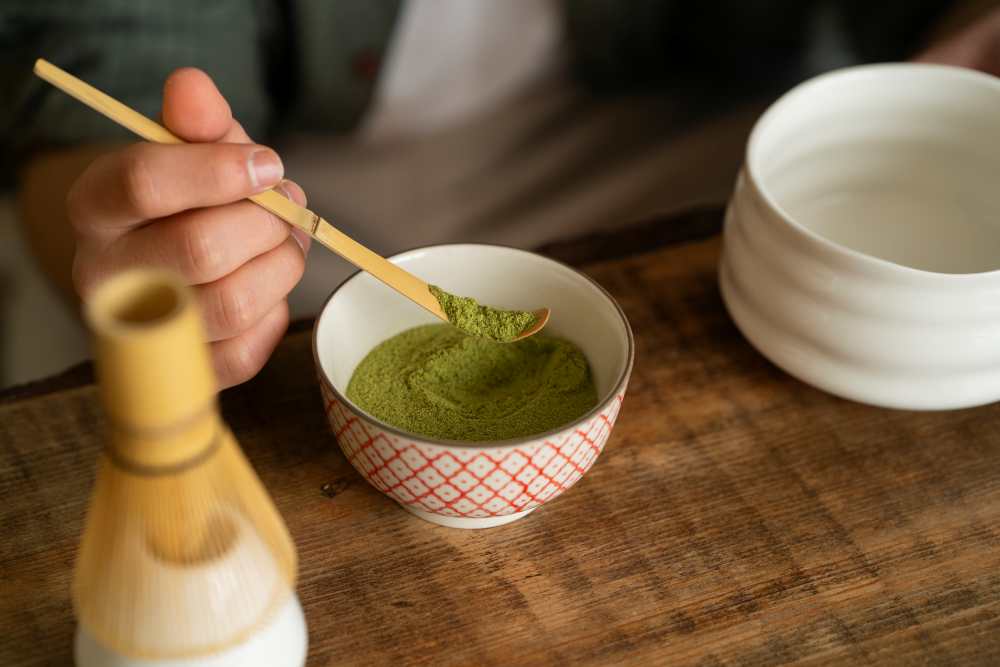
What is matcha and how does it work?
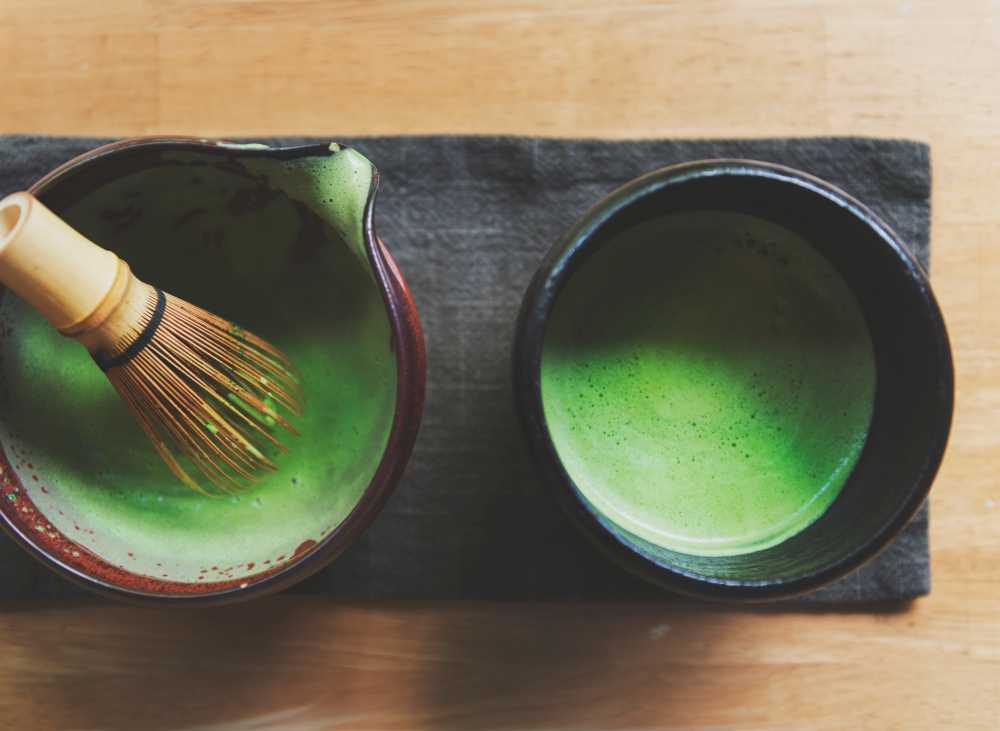
Matcha is more than just a trendy green powder. It is a finely ground green tea with a long tradition in Japanese culture, remaining an integral part of local tea rituals to this day. Currently, however, it is also very popular in Europe, not only as an alternative to coffee, but also as part of smoothies, desserts, or a calm morning routine.
Unlike regular green tea, matcha tea involves consuming the entire leaf rather than just an infusion. This means you get significantly more nutrients, antioxidants, and active substances, including caffeine. This is precisely why matcha tea has a much more pronounced effect than classic green tea.
Matcha contains a combination of caffeine and L-theanine, an amino acid that induces a sense of calm and improves focus. This synergistic effect ensures that matcha provides energy gradually and without sharp fluctuations, free from a sudden "jolt" followed by a crash, as we know it from strong coffee. Instead of nervousness, a feeling of alert well-being takes over.
Matcha is also a rich source of:
- Chlorophyll
- Catechins (especially EGCG)
- Vitamin C
Thanks to its composition, it is a great helper for supporting immunity, detoxification, and antioxidant cell protection. It has a mildly sweet, grassy-earth flavor most commonly combined with milk (matcha latte), but it also fits well into porridges, raw desserts, or protein drinks.
Does matcha have side effects?
Matcha has a range of positive effects. It delivers energy, supports focus, improves mood, and serves as a rich source of antioxidants. However, like any natural substance, it can have its downside, especially if you drink it in excessive amounts or aren't exactly a fan of caffeine.
At higher doses, matcha can cause:
- Nervousness and restlessness (especially in more sensitive individuals)
- Insomnia if drunk late in the afternoon or evening
- Nausea or stomach irritation, primarily on an empty stomach
- Increased heart rate or blood pressure if you are sensitive to caffeine
In rare cases, long-term consumption of excessive amounts of matcha can strain the liver, but this applies mostly to extremely high doses. Otherwise, matcha is considered a safe beverage that can be enjoyed every day.
Main differences between kratom and matcha
Although both kratom and matcha are often classified as stimulants, they differ in many aspects – not only in their effects, but also in appearance, taste, and dosage. You will most frequently find kratom as a green powder or dried leaves with a typically bitter, earthy taste. Matcha, on the other hand, stands out with its bright green color, velvety consistency, and gently sweet taste with a hint of umami, which is typical for high-quality Japanese teas.
A difference also lies in price. With kratom, it depends on quality and strain, whereas with matcha, its grade plays a role (the most expensive being so-called ceremonial grade).
Article TIP
The dosage of both plants is relatively precise: for kratom, it ranges in grams depending on the desired effect (low doses stimulate, higher ones tend to calm), while for matcha, 1–2 grams per cup is usually enough.
Chemically, kratom is based on alkaloids affecting brain receptors, while matcha scores points with its combination of caffeine, L-theanine, and antioxidants, thanks to which it provides a smooth and balanced energy supply.
From a safety standpoint, both drinks are considered relatively safe when used sensibly. With kratom, it is important not to exceed recommended doses and not to combine it with other substances. With matcha, individuals who tolerate caffeine poorly or have specific health conditions should exercise caution.
How to choose between kratom and matcha?
Each of these drinks has its specific properties and benefits. If you are hesitating over which one is right for you, take a look at the clear comparison below to help you see what you can expect from each.
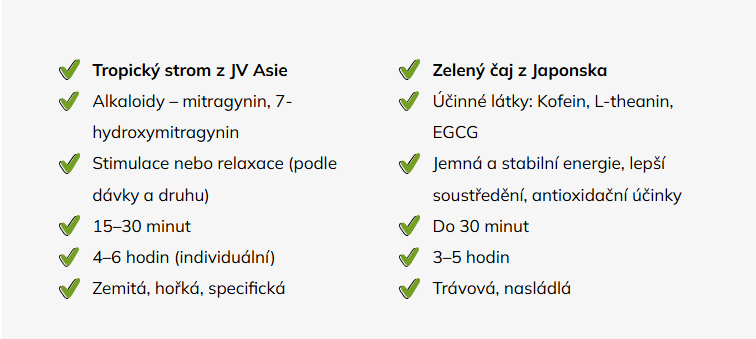
Kratom and matcha differ in many ways—not only in origin and effect, but also in when and why to use them. Matcha offers clean and stable energy for every day without a major impact on your mindset. It depends entirely on your personal preference.
When to reach for which – and what about combining them?
Considering whether kratom or matcha suits you better? The answer mainly depends on what you currently need. If you have a demanding day ahead requiring focus without over-stimulation, matcha is a great choice, supporting performance gently, stably, and without crashes. Conversely, when you are looking for stronger mood support, tension relief, or an alternative for unwinding after work, kratom might be more suitable (naturally in a dose and strain that fits you).
And what if you think about combining both? Proceed with caution here. Although these are two natural substances, their effects take place on completely different levels within the body. Kratom affects brain receptors differently than the caffeine in matcha, and combining them can lead to unpredictable reactions ranging from over-stimulation to unpleasant physical stress. Generally, mixing these two plants is therefore not reccommended.
If you want to try both drinks, rather alternate them based on the situation than mixing them into a single day. Your body will tell you what suits it best.
What about kratom legality? Yes, but not everywhere
While matcha is completely legal and unrestricted worldwide, the situation with kratom is somewhat more complex. In Hungary, it occupies a legal gray area as an unregulated botanical product. For example, in the Czech Republic, kratom is classified as a psychomodulatory substance - all vendors offering it must hold valid licenses. Sales are restricted to individuals over 18 years of age, through specialized shops or regulated e-shops. Open sales via vending machines or public advertising are not permitted.
If you are planning to travel with kratom, definitely pay attention. The legality of kratom varies across different countries, sometimes quite significantly. While kratom is fully permitted in some EU states (e.g., Germany or Austria), it is banned or strictly regulated in others (e.g., France, Italy, or Poland).
Article TIP
Before packing kratom into your suitcase, we recommend checking its status in your destination in advance. Legal regulations can change, and what was legal last year might not be today. Therefore, we regularly update our article for you: Where Is Kratom Legal? Kratom Legality in 2026.
Whether you reach for kratom or matcha tea, it always depends on what you expect from the drink and how you want to feel. Each of these helpers works a bit differently. Kratom acts more deeply on the psyche and body, whereas matcha offers gentle and stable stimulation without fluctuations. Neither of them is universally "better"—it depends entirely on you, your current need, and your sensitivity.
Remember that even natural substances deserve respect. Experiment, observe the effects, and give your body time. You might find that matcha works best for you in the morning and kratom in the evening after a demanding day, or completely the other way around. And if you are travelling, keep the legislative side of things in mind, especially regarding kratom.
Frequently asked questions
How much matcha per day?
The usual recommended dose of matcha is 1–2 grams daily, corresponding roughly to one cup of classic matcha tea or matcha latte. This portion contains approximately 60–80 mg of caffeine – similar to a weaker cup of coffee – but thanks to the presence of L-theanine, it acts much more evenly and smoothly. And the good news? The body does not build a tolerance to matcha as quickly as it does to coffee, so you can enjoy it regularly without worry, ideally during the morning or early afternoon.
When not to drink matcha?
Although matcha is generally very well tolerated, it is not always the right time to have a cup. Due to its caffeine content, it can disrupt sleep in more sensitive individuals, so we do not recommend drinking it in the evening or right before bedtime. The ideal time for matcha is in the morning or early afternoon when you need a boost. Watch out for consuming it on an empty stomach as well; for some people, it can cause nausea or irritation. If you are trying it for the first time, try incorporating it after a light breakfast. And if you are pregnant, breastfeeding, or have heart or blood pressure issues, it is always best to consult a doctor about consuming matcha.
Disclaimer
This article is for informational purposes only and does not replace professional medical or addiction-related consultation. It does not contain recommendations regarding dosage or frequency of use. Kratom is intended strictly for adults aged 18 and over. Do not use it during pregnancy, while breastfeeding, in combination with alcohol or medication, or before driving vehicles.
Sources
WIKIPEDIE. Kofein [online]. Available from: https://cs.wikipedia.org/wiki/Kofein
HEALTHLINE. 7 Proven Ways Matcha Tea Improves Your Health [online]. Available from: https://www.healthline.com/nutrition/7-benefits-of-matcha-tea
EATINGWELL. What Happens to Your Body When You Drink Matcha Every Day [online]. Available from: https://www.eatingwell.com/matcha-health-benefits-11705379
NIH. Health Benefits and Chemical Composition of Matcha Green Tea: A Review [online]. Available from: https://pmc.ncbi.nlm.nih.gov/articles/PMC7796401/
HACKENSACK MERIDIAN HEALTH. Kratom: What Are The Health Benefits vs. Risks? [online]. Available from: https://www.hackensackmeridianhealth.org/en/healthu/2023/06/23/kratom-health-benefits-and-risks